Digital marketing is the practice of promoting a business, product or brand through online channels such as search engines, social media, email, websites and paid ads, so you can reach customers where they already spend…
 Ayaan Malik10 min read
In this article
- What is digital marketing?
- How does digital marketing work?
- Types of digital marketing
- 1. Search engine optimization (SEO)
- 2. Content marketing
- 3. Social media marketing
- 4. Paid advertising (PPC)
- 5. Email marketing
- 6. Influencer and affiliate marketing
- 7. Video marketing
- 8. Your website: the hub
- Which channel is right for you?
- Digital marketing vs traditional marketing
- Benefits and limits of digital marketing
- Digital marketing in Pakistan
- Digital marketing examples
- How to build a digital marketing strategy in 7 steps
- Where should a small business start?
- Digital marketing tools to start with
- Common digital marketing mistakes
- Frequently asked questions
- What is digital marketing in simple words?
- What are the main types of digital marketing?
- Is digital marketing better than traditional marketing?
- How much does digital marketing cost?
- How long does digital marketing take to work?
- Do I need a website for digital marketing?
- Is digital marketing worth it for small businesses in Pakistan?
- Need help with digital marketing?
Digital marketing is the practice of promoting a business, product or brand through online channels such as search engines, social media, email, websites and paid ads, so you can reach customers where they already spend their time and measure what works. In plain terms, it’s how a business gets found, gets trusted and gets chosen online. This guide explains how digital marketing works, the main types, how it compares with traditional marketing, what it looks like in Pakistan, and how to start without wasting money.
What is digital marketing?
Digital marketing is any marketing that uses the internet or connected devices to reach people. A Google search ad, an Instagram reel, a newsletter, a blog post that ranks in search results and a Facebook ad are all digital marketing.
A useful way to think about it is that digital media is the content and platforms (websites, videos, social posts, podcasts, emails), while digital marketing is the strategy of using them to reach a business goal. Every digital marketing campaign uses digital media, but not all digital media is marketing.
The goal can be awareness (people know you exist), leads (people enquire), sales (people buy) or loyalty (people come back and recommend you). Good digital marketing picks one main goal at a time.
How does digital marketing work?
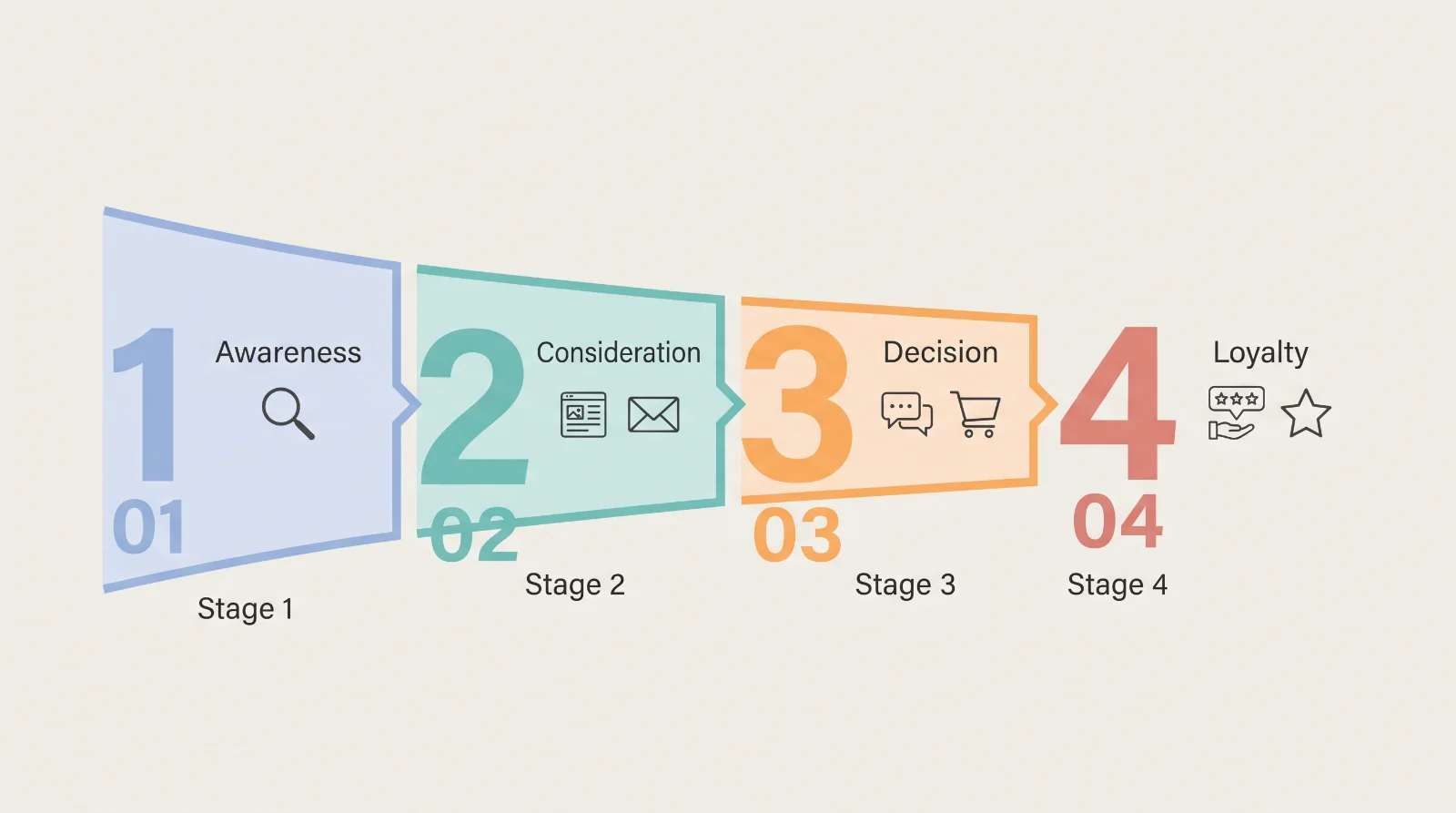
Digital marketing follows the customer’s journey. Each stage has a different question in the customer’s mind, so each uses different channels.
Stage | What the customer is thinking | Common channels | What to measure |
|---|---|---|---|
Awareness | “I have a problem” | SEO, social posts, video, display ads | Reach, impressions, website visits |
Consideration | “Who can solve it?” | Blog content, email, retargeting ads, reviews | Engagement, email sign-ups, time on page |
Decision | “Should I buy from them?” | Search ads, case studies, demos, WhatsApp or live chat | Leads, calls, conversion rate |
Loyalty | “Was it worth it?” | Email, social communities, referral offers | Repeat purchases, reviews, retention |
The channels work best together. A customer might see your Instagram video, search your brand on Google a week later, read a case study on your website and then message you. No single channel did all the work, which is why tracking the whole journey matters.
Digital marketing also runs on data. Free tools such as Google Analytics and Google Search Console show which channels bring visitors, which pages convert and where people leave.
Types of digital marketing
These are the main channels, what each one does and who it suits.
1. Search engine optimization (SEO)
SEO is the process of improving your website so it appears higher in unpaid Google results when people search for what you offer. It covers your content, your site’s technical health (speed, mobile friendliness, crawlability) and your authority (links from other trusted sites). Results build over months and keep working without a per-click cost. Google’s own SEO Starter Guide is the best free official reference. Our Abacus BPO case study reports 4.56 million search impressions in 12 months, which shows what a sustained SEO effort can do.
2. Content marketing
Content marketing means creating useful articles, guides, videos and tools that answer your customers’ questions. It builds trust, feeds SEO, and gives you something worth sharing on social media and in email.
3. Social media marketing
This is using platforms such as Facebook, Instagram, LinkedIn, TikTok, YouTube and X to build awareness, community and sales, through both organic posts and paid promotion. Choose platforms by where your customers actually spend time, not by which is trending.
4. Paid advertising (PPC)
With paid advertising you pay to show ads on search engines, social platforms, video sites and other websites, often per click. It brings fast, precisely targeted traffic, but the traffic stops when the budget stops.
5. Email marketing
Email reaches people who agreed to hear from you: newsletters, offers, order updates and abandoned-cart reminders. You own your list, so you aren’t dependent on a platform’s algorithm.
6. Influencer and affiliate marketing
You partner with creators or affiliates who promote your business to their audience, paid per post or per sale. It works through trust, so pick partners whose audience matches yours and make sure paid partnerships are clearly disclosed.
7. Video marketing
Short videos (Reels, Shorts, TikTok) and longer YouTube content show your product, explain ideas and share customer stories. Video is especially strong for awareness and for products people want to see before buying.
8. Your website: the hub
Every channel above sends people to your website or app. If it’s slow, confusing or hard to use on a phone, you lose the customers you paid to attract. A fast, clear website with an obvious next step (call, form, WhatsApp, buy) makes every other channel work harder.
Which channel is right for you?
Channel | Speed of results | Cost control | Best for |
|---|---|---|---|
SEO | Slow (months) | No per-click cost, but needs ongoing effort | Steady, long-term traffic |
Content marketing | Slow to medium | Moderate | Trust, supporting every other channel |
Organic social media | Medium | Low cash cost, high time cost | Community and brand awareness |
Paid advertising | Fast (days) | Fully adjustable budget | Quick leads and sales |
Email marketing | Fast once you have a list | Low | Repeat sales and nurturing |
Influencer marketing | Fast to medium | Varies widely | Launches and building trust |
Video marketing | Medium | Varies | Awareness and product demos |
Digital marketing vs traditional marketing
Feature | Digital marketing | Traditional marketing (TV, radio, print, billboards) |
|---|---|---|
Targeting | Specific by location, interests and behaviour | Broad, based on who uses the medium |
Measurement | Clicks, leads and sales can be tracked | Harder, relies on estimates and surveys |
Budget | Start small and adjust any time | Often larger commitments up front |
Speed of change | Edit or pause immediately | Slow to change once booked |
Interaction | Two-way: comments, messages, replies | Mostly one-way |
Reach | Local to global | Limited to the medium’s area or audience |
Traditional marketing isn’t dead. Billboards, radio and print can still work for local or older audiences, and many strong campaigns combine both. But for most small businesses, digital marketing offers more control and clearer proof of what the money is doing.
Benefits and limits of digital marketing
Benefits
• You can target the people most likely to buy.
• You can start with a small budget and scale what works.
• You can measure results and stop spending on what doesn’t.
• You can talk with customers directly and quickly.
• You can reach local and international customers from the same website.
Limits
• Competition is high, and popular keywords and audiences get expensive.
• Platforms change their rules and algorithms, so results can shift.
• Most channels need consistent effort. One post or one campaign rarely changes a business.
• Without proper tracking, it’s easy to waste money without knowing.
Digital marketing in Pakistan
The audience is large. DataReportal’s Digital 2026: Pakistan report counts 117 million internet users in the country in October 2025 and 79.9 million social media user identities, equal to 31.2 percent of the population. These identities may not all be unique individuals, but the scale is clear.
On individual platforms, audience estimates compiled by NapoleonCat from Meta’s advertising data put Pakistan at about 71.2 million Facebook users and about 26.3 million Instagram users in June 2026. On Facebook, the largest age group is 25–34 and about 75 percent of users are men. On Instagram, the largest group is 18–24 and about 64 percent are men.
What that means in practice:
• Facebook and Instagram are core channels for consumer brands, from clothing to food to services.
• Mobile comes first. Your website and landing pages must load fast and read well on a phone.
• Audiences skew young and male. If your customers are mostly women, test your targeting and creative rather than assuming the platform reaches them.
• Local search matters. A complete Google Business Profile helps customers in Lahore, Karachi, Islamabad and other cities find you.
• Language matters. Many people search and read in Urdu or Roman Urdu as well as English, so consider content in both.
• Make it easy to message you. Many businesses handle enquiries over WhatsApp, so put that option where customers can see it.
Digital marketing examples
These are illustrative examples of how the channels combine, not client results.
• A local dental clinic completes its Google Business Profile, collects patient reviews, publishes pages for each treatment, and runs a small Facebook ad for check-ups in its city.
• An online clothing brand posts Reels showing its collections, works with a few creators, and sends an email reminder to shoppers who left items in their cart.
• A software company publishes guides that rank in Google, shares them on LinkedIn, and follows up sign-ups with a short email series.
How to build a digital marketing strategy in 7 steps

1. Set one clear goal. For example, “30 qualified enquiries a month” is better than “more visibility.”
2. Define your customer. Who are they, what do they search for, where do they spend time online?
3. Look at your competitors. See which channels they use and where they seem weak.
4. Pick one or two channels. Start where your customers already are and where you can be consistent.
5. Plan your content and offer. Decide what you’ll say and what action you want people to take.
6. Set up tracking before you spend. Install Google Analytics and Search Console, and track enquiries, calls and purchases.
7. Review monthly and adjust. Keep what works, fix what’s close, drop what isn’t.
Where should a small business start?
If you’re starting from zero, this order gives the best return for most businesses:
1. A fast, clear website that works on mobile, with an obvious way to contact you.
2. A complete Google Business Profile, if you serve a local area.
3. One social media profile on the platform where your customers are, kept active.
4. A way to collect emails or WhatsApp contacts from interested people.
5. A small, tracked paid campaign to test what brings enquiries.
6. Content and SEO as a steady long-term investment.
Digital marketing tools to start with
Purpose | Tools |
|---|---|
See how people find your site | Google Search Console, Google Analytics |
Show up in local searches | Google Business Profile |
Find keywords people search | Google Keyword Planner |
Run and manage social ads | Meta Ads Manager and Meta Business Suite |
Design posts and graphics | Canva |
Send email campaigns | Mailchimp, Brevo |
Build dashboards | Looker Studio |
Most of these have a free plan or free tier, so you can begin without a large budget.
Common digital marketing mistakes
• Having no goal. Without one, you can’t tell whether anything worked.
• Trying every channel at once. Spread thin, nothing gets enough attention.
• Sending traffic to a poor website. Slow pages and unclear offers waste ad spend.
• Buying followers or fake engagement. It inflates numbers but brings no customers.
• Not tracking results. If you can’t see enquiries and sales by channel, you can’t improve.
• Quitting too early. Content and SEO take months to build, and paid campaigns need testing.
Frequently asked questions
What is digital marketing in simple words?
Digital marketing is promoting your business online, through channels like Google search, social media, email and websites, so more of the right people find you and choose you.
What are the main types of digital marketing?
The main types are SEO, content marketing, social media marketing, paid advertising, email marketing, influencer and affiliate marketing, and video marketing.
Is digital marketing better than traditional marketing?
For most small businesses it offers more control, sharper targeting and clearer measurement. Traditional marketing can still work well for some local audiences, and the two can be combined.
How much does digital marketing cost?
It depends on the channels, your industry’s competition, and whether you do the work yourself or hire an agency. Costs usually include ad spend paid to platforms plus either your time or agency fees. A sensible start is a small test budget you can afford while you learn what works.
How long does digital marketing take to work?
Paid ads can bring visitors within days, though improving results takes weeks of testing. SEO and content marketing usually take several months to build momentum.
Do I need a website for digital marketing?
In most cases, yes. Your website is the place where search, social and email traffic can learn about you and contact you. A social profile alone gives you less control and fewer ways to convert visitors.
Is digital marketing worth it for small businesses in Pakistan?
With about 117 million internet users and tens of millions on Facebook and Instagram, most customers can be reached online. It’s worth it if you set a clear goal, track results and begin with a small, focused budget.
Need help with digital marketing?
If you’d like a clear plan for your business, tell us about your project and you’ll get a plan, timeline and price within 48 hours. You can also see our website development service, since a good website is the foundation of every digital marketing channel.