Search for a mobile app development company in Pakistan and you’ll find more than a thousand of them. Good Firms alone lists 1,002 as of July 2026, and listed hourly rates run from about $10 to more than $300.
 Sofia Martins15 min read

In this article
- Key takeaways
- Why Choosing a Mobile App Development Company in Pakistan Is Harder Than It Looks
- What Does a Mobile App Development Company Actually Do?
- Mobile app development company vs agency vs freelancer vs in-house team
- How to Choose a Mobile App Development Company in Pakistan: The 8-Point Scorecard
- 1. Check live apps, not screenshots (20 points)
- 2. Make them explain the technical choices (15 points)
- 3. Look closely at the process (15 points)
- 4. Meet the people who will build it (10 points)
- 5. Settle ownership before you start (10 points)
- 6. Ask about security and testing (10 points)
- 7. Call the references (10 points)
- 8. Get the support terms in writing (10 points)
- 10 Red Flags When Hiring an App Development Company
- 20 Questions to Ask Every Mobile App Development Company Before You Sign
- How Much Does a Mobile App Development Company in Pakistan Charge?
- Pricing models compared
- How Long Does It Take to Build a Mobile App?
- Native vs Cross-Platform: What Your App Company Should Explain
- What to Put in Writing: Contracts and Ownership
- How to Shortlist a Mobile App Development Agency in 7 Days
- 7 Mistakes People Make When Choosing an App Development Company
- How The Craft Media Approaches App Projects
- Frequently Asked Questions
- How do I choose the best mobile app development company in Pakistan?
- How much does it cost to develop a mobile app in Pakistan?
- How long does mobile app development take?
- Should I hire a mobile app development agency or a freelancer?
- Is native or cross-platform better for my app?
- Will I own the source code?
- What should I receive at launch?
- Can a Pakistani company work with international clients?
- What happens after the app launches?
- Final Thoughts: Choose for Fit, Not for the Lowest Price
- Ready to Build Your App With a Team You Can Verify?
Search for a mobile app development company in Pakistan and you’ll find more than a thousand of them. Good Firms alone lists 1,002 as of July 2026, and listed hourly rates run from about $10 to more than $300. Every one of them has a polished portfolio and promises a fast launch.
So how do you tell the team that will deliver from the one that will burn your budget? The answer isn’t the cheapest quote or the flashiest website. It’s a repeatable way to compare companies, and this guide gives you one: an 8-point scorecard, real market and cost data, the red flags to walk away from, and 20 questions to ask before you sign anything.
Key takeaways
• Pakistan has more than 1,000 listed app companies. Directory listings are a starting point, not proof of quality.
• Score every shortlisted mobile app development company on the same 8 criteria using the 100-point scorecard below, and walk away from anything under 70.
• Listed hourly rates run from about $10 to $333, and the Good Firms median for Punjab is $37. Compare fixed-price proposals with a clear scope, not rates alone.
• Get code ownership, store accounts and payment milestones in writing before work starts.
• A first version typically takes 8–16 weeks. Be wary of anyone promising dramatically faster.
Why Choosing a Mobile App Development Company in Pakistan Is Harder Than It Looks
The supply is huge, and the spread is wide. Good Firms lists 1,002 mobile app development companies in Pakistan (July 2026) and 604 verified firms in Punjab alone (September 2026), with a median hourly rate of $37 in Punjab. On Design Rush, which listed 376 Pakistani app companies in June 2026, the average hourly rates shown by individual firms range from around $10 to over $300.
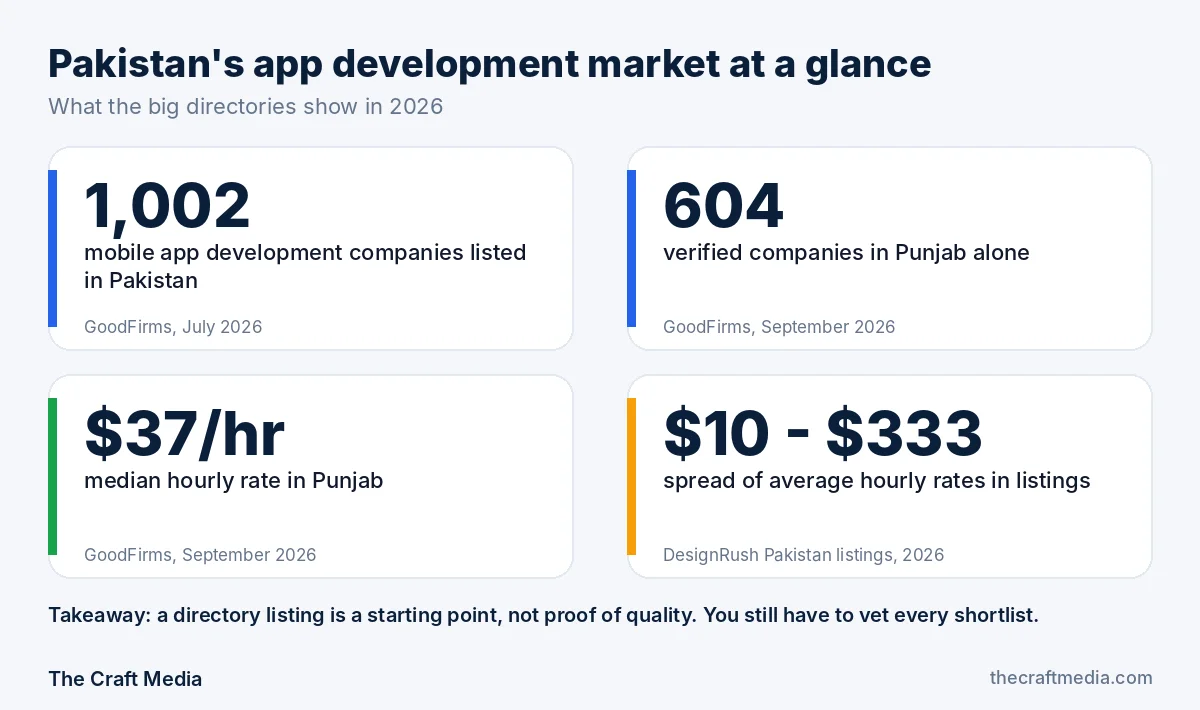
That range tells you something important: price alone can’t be your filter. A $10 rate and a $300 rate can both come with a polished pitch, and neither guarantees a working app. Directories are useful for building a long list, but they can’t show you how a team handles changing requirements, missed deadlines or bugs after launch. That part is your job, and it’s why you need a method.
The demand behind this market is real. Data Reportal counted about 117 million internet users in Pakistan in October 2025, so businesses building for local customers, and exporters serving overseas ones, have good reasons to build apps. The risk is rarely a shortage of vendors. It’s picking the wrong one.
What Does a Mobile App Development Company Actually Do?
A good mobile app development company covers the whole journey from idea to a live, supported product, not just the coding. Look for these capabilities:
• Discovery and strategy: defining users, goals, features and a realistic first version.
• UX and UI design: screens, flows and a clickable prototype you can test before code is written.
• App development: iOS, Android or cross-platform apps, plus the backend, APIs and admin panel.
• Quality assurance: testing on real devices, bug fixing and performance checks.
• Security: protecting user data, logins and payments.
• Launch: preparing and submitting the app to the App Store and Google Play.
• Support and growth: updates, new features, analytics and marketing after launch.
Mobile app development company vs agency vs freelancer vs in-house team
The terms “company” and “agency” are often used interchangeably. A mobile app development agency typically bundles strategy, design, engineering and marketing, while some companies focus mainly on engineering. Here is how the four options compare:
Option | Best for | Strengths | Risks |
|---|---|---|---|
Mobile app development company or agency | Most business apps and startups | Full team (design, engineering, QA, project management), clear process | Quality varies widely, so vet carefully |
Freelancer | Small, well-defined tasks | Low cost, flexible | One person is a single point of failure, and skills gaps are common |
In-house team | Large, long-term products | Deep product knowledge, full control | Slow and costly to hire, with ongoing salary overhead |
Dedicated team from an outsourcing partner | Scaling an existing product | Capacity without hiring | Needs strong management on your side |
How to Choose a Mobile App Development Company in Pakistan: The 8-Point Scorecard
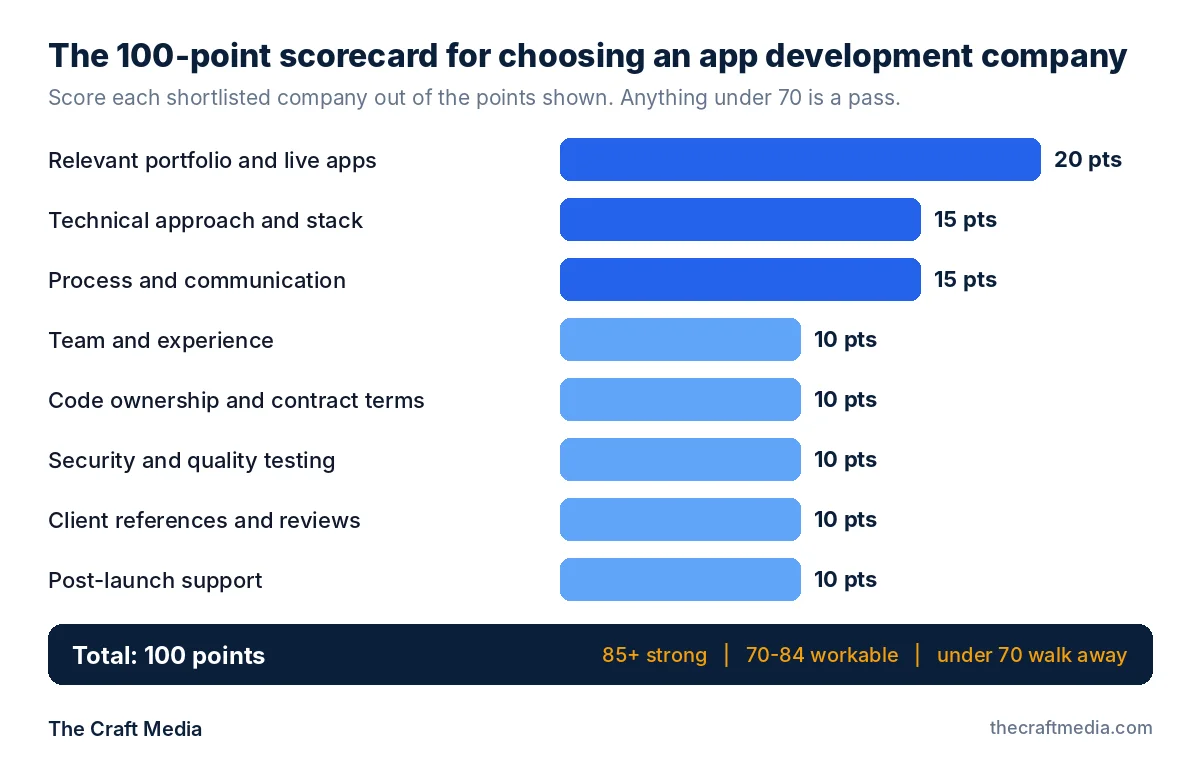
Use the same scorecard on every company you shortlist, so you compare facts instead of impressions. Each criterion carries points that add up to 100.
Criterion | Points | What good looks like | How to verify |
|---|---|---|---|
Relevant portfolio and live apps | 20 | Live apps in the stores, similar in scale or industry to yours | Download the apps, check ratings, crashes and updates |
Technical approach and stack | 15 | Clear reasons for native or cross-platform, a scalable backend | Ask them to explain trade-offs in plain language |
Process and communication | 15 | Discovery phase, regular demos, a named point of contact | Ask to see a sample project plan and meeting rhythm |
Team and experience | 10 | Named, senior people on your project | Ask who will actually build it and meet them |
Code ownership and contract terms | 10 | You own code, designs and accounts, with milestones in writing | Read the draft contract before you commit |
Security and quality testing | 10 | A written QA and security plan | Ask how they test and which standards they follow |
Client references and reviews | 10 | Past clients willing to talk, consistent reviews | Call two references and read third-party reviews |
Post-launch support | 10 | A defined support period and response times | Get support terms in the proposal |
Scoring: 85 or more is a strong choice, 70 to 84 is workable with some negotiation, and under 70 means walk away.
1. Check live apps, not screenshots (20 points)
A portfolio page can show anything. A live app can’t hide as much. Ask for App Store and Google Play links, install the apps, and use them. Look at the ratings, the review comments, how often the app is updated, and whether it crashes. Pay attention to whether the company built an app like yours: a marketplace is not the same as a booking app or a fintech product.
2. Make them explain the technical choices (15 points)
A good team can tell you why it recommends native iOS and Android, a cross-platform framework, or a progressive web app for your case, and what each choice costs you. If the answer is always “we use the same stack for everything,” be careful.
3. Look closely at the process (15 points)
Most app projects fail because of unclear scope and poor communication, not because the code was bad. Look for a discovery phase before development, a design preview you can click through, regular demos, and one person who is responsible for your project.
4. Meet the people who will build it (10 points)
Some companies sell with senior staff and then hand your project to juniors. Ask who will work on it, what their experience is, and whether you can speak with them before you sign.
5. Settle ownership before you start (10 points)
Your source code, design files, and the developer accounts that publish your app should belong to you. We cover exactly what to put in writing below.
6. Ask about security and testing (10 points)
Apps handle logins, personal data and sometimes payments. A serious team follows recognized security guidance, such as the OWASP Mobile Top 10, tests on real devices, and plans for app store review rules.
7. Call the references (10 points)
Two short calls will teach you more than twenty testimonials. Ask whether the project was on time and on budget, how problems were handled, and whether they would hire the company again. Then compare what you hear with third-party reviews on Good Firms, Clutch and Design Rush.
8. Get the support terms in writing (10 points)
Apps need updates when iOS and Android change, bugs appear after real users arrive, and features get added. A company that disappears after launch leaves you stranded. Ask for a support period, response times and a clear price for ongoing work.
10 Red Flags When Hiring an App Development Company
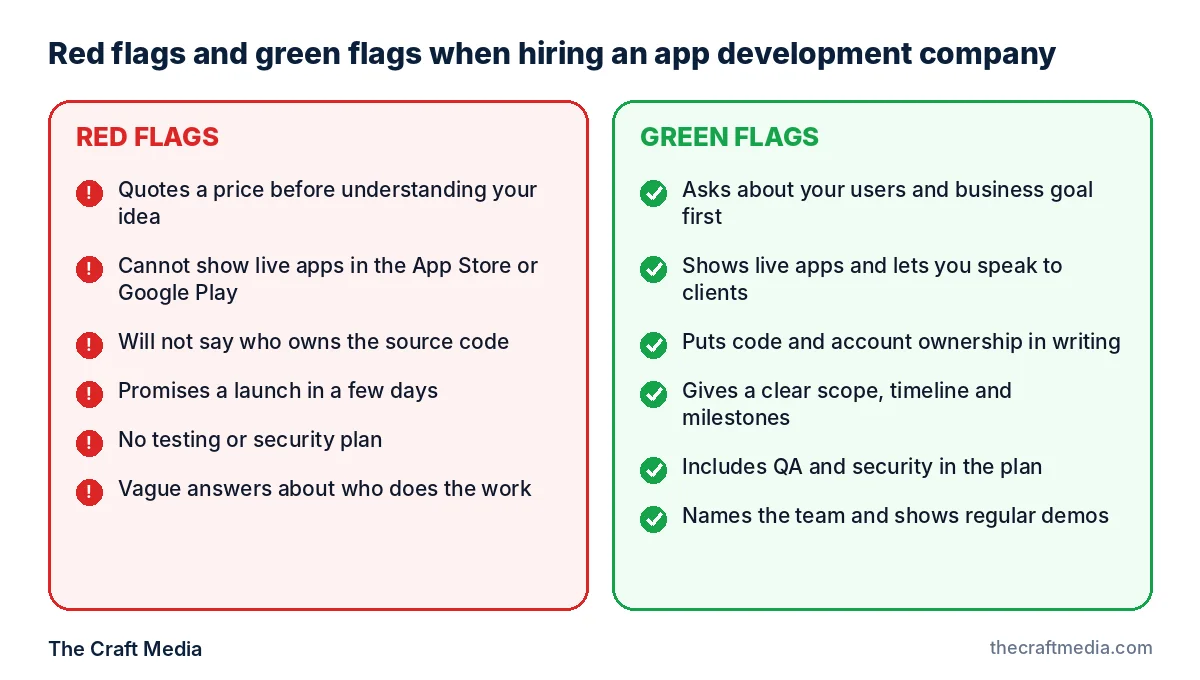
• They quote a price before asking about your users and business goals.
• They can’t show live apps in the App Store or Google Play.
• They avoid saying who will own the source code.
• They promise a launch in days or a very low fixed price for a complex app.
• They won’t let you speak to past clients.
• Nobody can tell you who will actually do the work.
• There’s no testing or security plan.
• Everything is “yes,” and they never push back on your scope.
• They ask for most of the payment up front, with no milestones.
• The contract is vague about support, delays and what happens if you part ways.
On the other side, green flags are the opposite: questions before quotes, live apps, written ownership, milestone payments, named teams and regular demos.
20 Questions to Ask Every Mobile App Development Company Before You Sign
Experience
1. Which live apps have you built that are similar to mine?
2. Can I speak with two clients from the last 12 months?
3. How many apps have you launched on both iOS and Android?
4. What was your hardest project, and how did you handle it?
Process
5. What happens in the discovery phase, and what do I receive from it?
6. Will I see a clickable design before development starts?
7. How often will I see working progress?
8. Who is my day-to-day contact, and how quickly do you reply?
9. How do you handle scope changes and extra requests?
Technical
10. Do you recommend native or cross-platform for my app, and why?
11. How will the backend scale if the app becomes popular?
12. How do you test, and on which devices?
13. How do you protect user data and payments?
Commercial and legal
14. Is the price fixed or hourly, and what’s included?
15. How are payments tied to milestones?
16. Who owns the code, designs and developer accounts?
17. What happens if we stop working together midway?
Support
18. What support do I get after launch, and for how long?
19. How much does ongoing maintenance cost?
20. How do you handle iOS and Android updates that break features?
How Much Does a Mobile App Development Company in Pakistan Charge?
There’s no single price, because apps vary enormously. What you can do is understand the rates and what drives the total.
Hourly rates. GoodFirms puts the median for Punjab-based companies at $37 an hour (September 2026). DesignRush listings for Pakistani firms show average rates from about $10 to over $300 an hour, with many sitting between roughly $25 and $50.
Lower rates can reflect junior teams, and higher ones can reflect specialised or enterprise work, so a rate alone doesn’t tell you quality.
A simple way to estimate. Total cost is roughly the hours required multiplied by the rate, plus third-party costs such as the Apple Developer Program, Google Play registration, servers and services like maps, payments or messaging.
For illustration only, if a team charging $37 an hour needs 600 hours, the build costs about $22,200. The 600 hours is an example, not a benchmark. The real figure comes from a defined scope.
Cost driver | Why it matters |
|---|---|
Number and complexity of features | Each feature adds design, build and testing time |
Platforms | iOS, Android or both, native or cross-platform |
Design | Custom UI, animations and user research take longer than templates |
Backend and integrations | Payments, maps, chat, notifications and admin panels add work |
Security and compliance | Handling sensitive data requires more design and testing |
Team seniority | Senior engineers cost more per hour but often finish faster with fewer defects |
Timeline | Rushing usually raises cost |
After-launch support | Ongoing updates and fixes are a continuing cost |
Also budget for store fees. Apple charges an annual fee for the Apple Developer Program, and Google Play charges a one-time registration fee. Check both for current amounts.
Be careful with the cheapest quote. A low hourly rate can end up costing more if the work needs rebuilding. Ask for a written scope and a fixed-price or capped proposal, and compare the same scope across companies.
Pricing models compared
Model | Best for | Watch out for |
|---|---|---|
Fixed price | Clear scope and a defined first version | Changes cost extra, so lock the scope early |
Time and materials | Evolving products | Needs a cap or regular budget reviews |
Dedicated team | Long-term, ongoing development | Requires active management from you |
How Long Does It Take to Build a Mobile App?
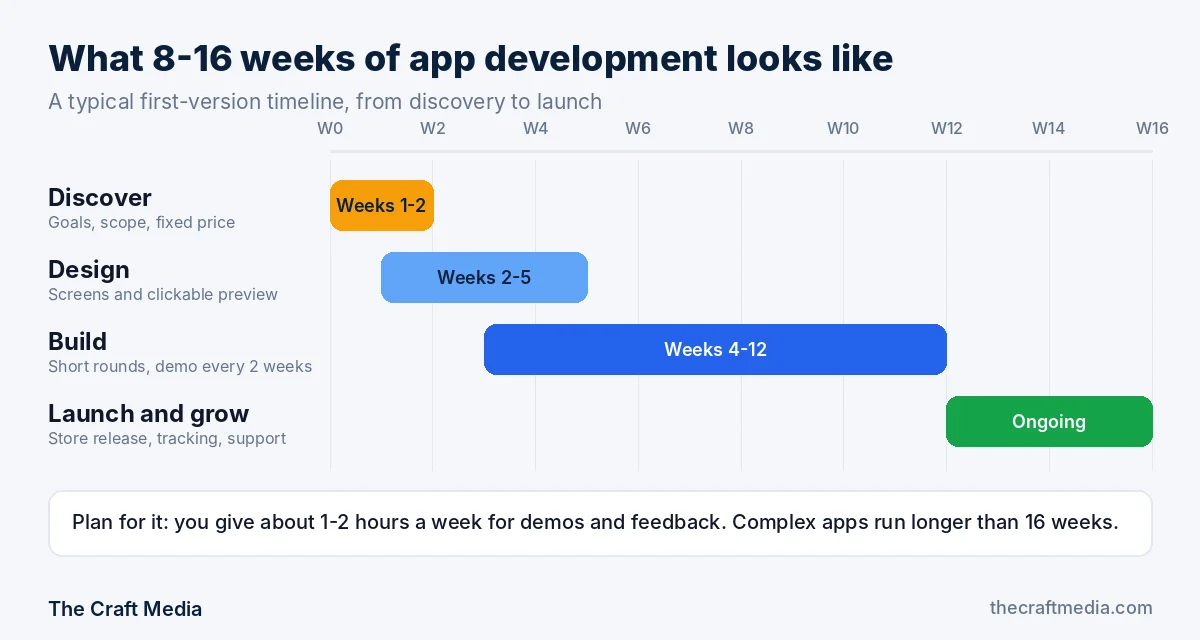
At The Craft Media, a first version of an app typically takes 8–16 weeks, depending on scope. Here is how that time is usually spent:
Phase | Typical timing | What happens |
|---|---|---|
Discover | Weeks 1–2 | Goals, users and scope are defined, and you get a clear plan and price |
Design | Weeks 2–5 | Every screen is designed and turned into a clickable preview you can test |
Build | Weeks 4–12 | Development in short rounds, with a progress demo about every two weeks |
Launch and grow | Ongoing | Store release, tracking, support and improvements |
Complex apps with many integrations take longer. If a company promises a full custom app in a couple of weeks, ask exactly what you’ll receive.
Native vs Cross-Platform: What Your App Company Should Explain
A strong mobile app development company will recommend an approach for your case and explain the trade-offs.
Approach | What it is | Best for | Trade-off |
|---|---|---|---|
Native (Swift for iOS, Kotlin for Android) | A separate app for each platform | Apps needing top performance or deep device features | Two codebases, higher cost |
Cross-platform (Flutter, React Native) | One codebase for both platforms | Most business apps and faster launches | Some advanced features may need native code |
Progressive web app | A website that behaves like an app | Simple tools and content | Fewer device features and no store presence by default |
What to Put in Writing: Contracts and Ownership
Before any work starts, make sure your agreement covers:
• Source code and design ownership. You own all code, designs and assets.
• Accounts in your name. Apple, Google Play, cloud hosting and analytics accounts should belong to you from day one.
• Scope and acceptance criteria. What is being built, and how you’ll agree it’s done.
• Milestone-based payments. Pay as work is delivered, not mostly up front.
• Change requests. How extra work is priced and approved.
• Confidentiality. A signed NDA for your idea and data.
• Warranty and support. A bug-fix period and clear support terms after launch.
• Handover. Documentation, credentials and a clean transfer if the relationship ends.
How to Shortlist a Mobile App Development Agency in 7 Days
1. Day 1: Write a one-page brief: the problem, the users, the must-have features and your budget range.
2. Day 2: Build a long list of 8 to 10 companies from directories and referrals.
3. Day 3: Check portfolios. Download the live apps and use them.
4. Day 4: Hold intro calls with your top 5 and ask the 20 questions above.
5. Day 5: Speak with references from your top 3.
6. Day 6: Compare proposals on the same scope and score each company with the 100-point scorecard.
7. Day 7: Choose your top company. If the project is large, start with a paid discovery phase before committing to the full build.
7 Mistakes People Make When Choosing an App Development Company
Mistake | Why it hurts | Fix |
|---|---|---|
Choosing on price alone | Rework often costs more than a fair quote | Compare scope and total cost, not rates |
Judging by screenshots | Portfolios can hide poor quality | Test live apps |
Starting without a brief | Scope creep and blown budgets | Write a one-page brief first |
Skipping the contract details | Disputes over code and accounts | Get ownership and milestones in writing |
Building everything at once | Slow launch, high cost | Launch a focused first version |
Ignoring support | Bugs and updates go unfixed | Agree support terms up front |
Not staying involved | The result drifts from your goal | Join weekly demos and give quick feedback |
How The Craft Media Approaches App Projects
Use the scorecard on us too. Here is how we work, so you can score it yourself.
• One team for everything. Design, engineering and marketing sit in one place, so your mobile app development is planned with UI/UX design and product strategy from the start.
• Fixed price, clearly scoped. After a free 30-minute call, we send a clear proposal with a fixed price or monthly fee, usually within 48 hours.
• You own everything. All code, design files and accounts belong to you, and we work in your accounts from day one.
• You see progress. Weekly demos and a shared chat show what’s done, what’s next and what it costs. We ask for about 1–2 hours a week of your time.
• Quality and support. QA, support and maintenance are part of the plan, with 30 days of free support after launch and care plans after that.
• Experienced people. Our team averages 8+ years of experience, and the people you meet are the people who do the work.
See how we deliver end to end in our Splice Packages case study, where we built a shop-and-ship website and warehouse system for a package forwarder, and how we treat speed in the Stardom Now project, which reports a 100 Google PageSpeed score on desktop.
Browse all of our work, see how we work, or visit the Craft Media homepage and our full list of services.
Frequently Asked Questions
How do I choose the best mobile app development company in Pakistan?
Build a long list from directories and referrals, then score each company on the same criteria: live apps, technical approach, process, team, ownership, security, references and support. Speak with past clients, and compare written proposals on the same scope.
How much does it cost to develop a mobile app in Pakistan?
It depends on scope, platforms, design and integrations. The GoodFirms median hourly rate for Punjab is $37, and listed rates range from about $10 to over $300. Ask for a fixed-price proposal after a discovery phase to get a real number for your app.
How long does mobile app development take?
A focused first version typically takes 8–16 weeks, from discovery through design and build to launch. Complex apps take longer.
Should I hire a mobile app development agency or a freelancer?
A freelancer can suit a small, well-defined task. For a full app, an agency gives you a team covering design, engineering, testing and project management, which reduces the risk of a single point of failure.
Is native or cross-platform better for my app?
Native suits apps that need top performance or deep device features. Cross-platform frameworks like Flutter and React Native suit most business apps and can speed up launch and lower cost. Your company should explain the trade-offs for your case.
Will I own the source code?
You should. Make sure your contract says you own the code, designs and developer accounts, and that accounts are created in your name.
What should I receive at launch?
The live app in the stores, the full source code, design files, technical documentation, admin access, analytics set-up and a clear support plan.
Can a Pakistani company work with international clients?
Yes. Many companies in Pakistan serve clients in the US, UK and the Gulf. Agree on meeting times that overlap, communicate in writing, use a clear contract and tie payments to milestones.
What happens after the app launches?
Apps need updates for new iOS and Android versions, bug fixes and new features. Agree on a support period and ongoing maintenance terms before launch.
Final Thoughts: Choose for Fit, Not for the Lowest Price
The right mobile app development company isn’t the cheapest or the one with the loudest pitch. It’s the one that has built apps like yours, explains its choices clearly, puts ownership and milestones in writing, and stays with you after launch. Use the scorecard, ask the 20 questions, and trust what you can verify. If a company can’t answer plainly, move on.
Ready to Build Your App With a Team You Can Verify?
Tell us what you want to build, and within 48 hours you’ll get a clear plan, timeline and price. No strings attached.
• See our mobile app development service
• Or email info@thecraftmedia.com